Our blog
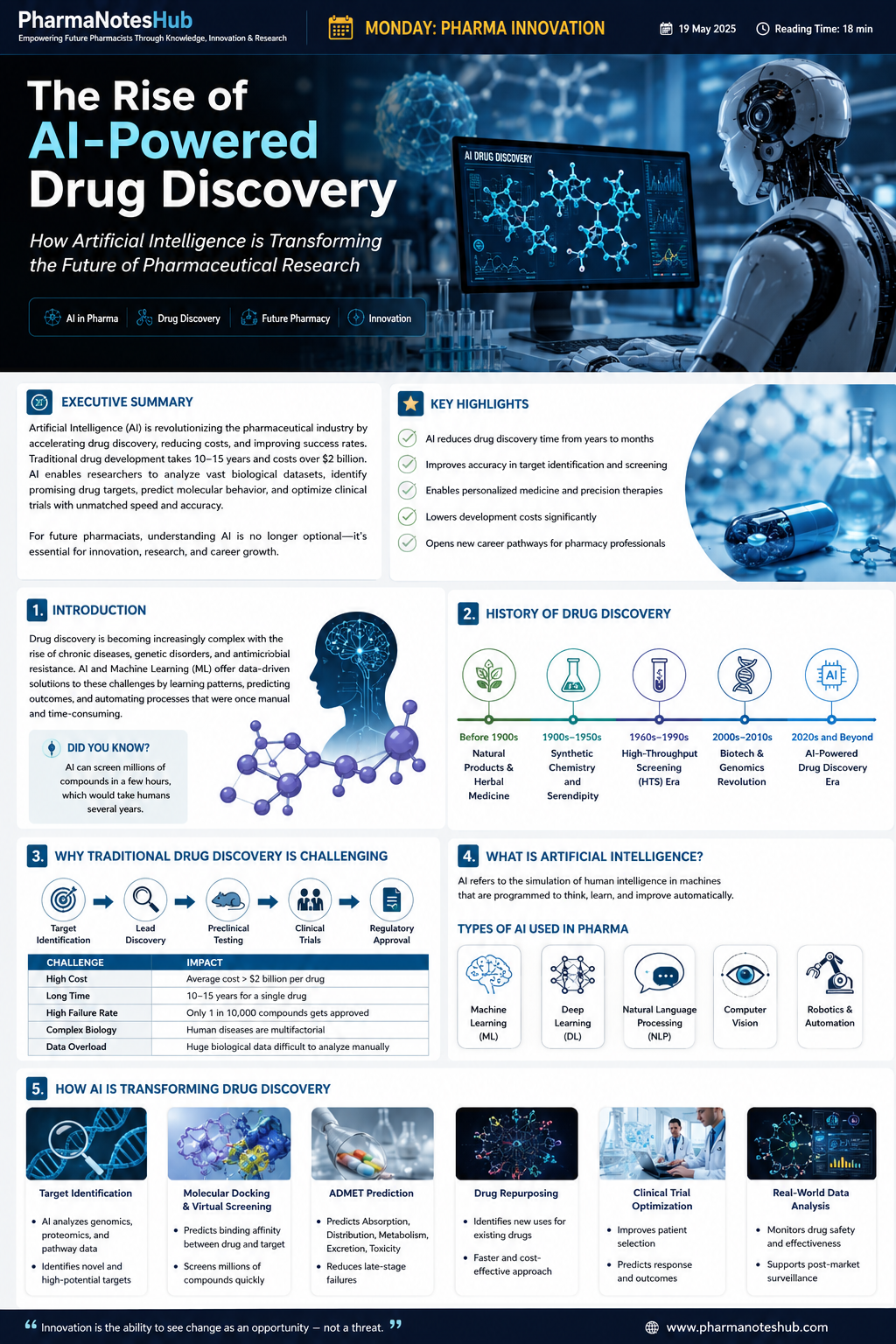
The Rise of AI-Powered Drug Discovery: How Artificial Intelligence Is Transforming the Future of Pharmaceutical Research
Executive Summary
Artificial Intelligence (AI) is rapidly changing the pharmaceutical industry. What once took scientists years to accomplish can now be achieved in months through advanced computational methods, machine learning algorithms, and large-scale biological data analysis.
Drug discovery has traditionally been one of the most expensive and time-consuming processes in healthcare. The average cost of bringing a new drug to market exceeds billions of dollars, while the development timeline often spans more than a decade. Despite these investments, most drug candidates fail during development due to toxicity, lack of efficacy, or unforeseen safety concerns.
AI offers a transformative solution. By analyzing vast datasets, predicting molecular interactions, identifying novel drug targets, and optimizing clinical trial designs, AI is helping pharmaceutical companies discover medicines faster and more efficiently than ever before.
This technological revolution is not replacing pharmaceutical scientists; rather, it is enhancing their capabilities and enabling them to make better-informed decisions. For pharmacy students and future researchers, understanding AI is becoming as important as understanding pharmacology, medicinal chemistry, and pharmaceutics.
Introduction
Healthcare is entering a new era driven by digital transformation. Artificial Intelligence, once considered science fiction, is now one of the most powerful tools in pharmaceutical research and development.
Over the last few decades, the pharmaceutical industry has faced increasing challenges. The complexity of human diseases, growing regulatory requirements, rising development costs, and high failure rates have created significant barriers to innovation. Researchers are expected to discover safer and more effective medicines while simultaneously reducing development timelines and costs.
AI is emerging as a critical technology capable of addressing these challenges.
Unlike traditional computational systems, AI can learn from data, recognize patterns, make predictions, and continuously improve its performance. In drug discovery, AI can analyze millions of molecular structures, predict biological activity, identify potential side effects, and prioritize the most promising drug candidates.
The integration of AI into pharmaceutical research is not merely a technological trend—it represents a fundamental shift in how medicines are discovered, developed, and delivered.
Evolution of Drug Discovery
The Traditional Era
Historically, medicines were discovered through observation and experimentation. Ancient civilizations relied heavily on natural products derived from plants, animals, and minerals.
The discovery of penicillin by Alexander Fleming in 1928 marked the beginning of modern pharmaceutical innovation. Subsequent decades witnessed remarkable advancements in synthetic chemistry, biotechnology, and molecular biology.
However, despite these scientific breakthroughs, drug discovery remained largely dependent on trial-and-error experimentation.
Researchers often screened thousands of compounds before identifying a single promising candidate. This approach required substantial resources and frequently resulted in failure.
Challenges in Traditional Drug Discovery
1. High Development Costs
The journey from laboratory discovery to regulatory approval is extraordinarily expensive.
Major cost contributors include:
- Research and development
- Preclinical testing
- Clinical trials
- Manufacturing validation
- Regulatory submissions
Every failed candidate increases the overall cost burden.
2. Long Development Timelines
A typical drug development process includes:
- Target identification
- Lead discovery
- Lead optimization
- Preclinical studies
- Phase I clinical trials
- Phase II clinical trials
- Phase III clinical trials
- Regulatory review
Completing these stages often requires more than ten years.
3. High Failure Rates
Only a small percentage of compounds entering development ultimately receive approval.
Common reasons include:
- Poor efficacy
- Unexpected toxicity
- Pharmacokinetic limitations
- Manufacturing challenges
This high attrition rate highlights the need for more predictive and efficient discovery methods.
Understanding Artificial Intelligence
Artificial Intelligence refers to computer systems capable of performing tasks that normally require human intelligence.
These tasks include:
- Learning from experience
- Recognizing patterns
- Solving problems
- Making predictions
- Processing language
- Understanding complex datasets
In pharmaceutical research, AI systems learn from enormous amounts of biological, chemical, and clinical data.
The more data they process, the more accurate their predictions become.
Major AI Technologies Used in Pharma
Machine Learning
Machine Learning enables computers to learn from historical data without explicit programming.
Applications include:
- Drug-target prediction
- Toxicity assessment
- Clinical outcome prediction
- Disease diagnosis
Deep Learning
Deep Learning utilizes neural networks that mimic the structure of the human brain.
These systems excel at:
- Image recognition
- Protein structure prediction
- Molecular property prediction
- Drug interaction analysis
Natural Language Processing (NLP)
NLP helps AI understand scientific literature, patents, clinical reports, and medical records.
Benefits include:
- Literature mining
- Automated knowledge extraction
- Competitive intelligence
How AI Is Transforming Drug Discovery
Target Identification
One of the earliest stages of drug development involves identifying biological targets associated with disease.
AI analyzes:
- Genomics data
- Proteomics data
- Disease pathways
- Clinical databases
to uncover novel therapeutic targets.
This process significantly reduces the time required to identify promising research opportunities.
Virtual Screening
Traditional compound screening requires testing thousands of molecules in laboratories.
AI-powered virtual screening can evaluate millions of compounds computationally.
Benefits include:
- Reduced laboratory costs
- Faster identification of candidates
- Higher screening efficiency
Molecular Docking
Molecular docking predicts how a drug interacts with its target protein.
AI improves:
- Binding affinity prediction
- Structural analysis
- Lead optimization
Researchers can prioritize compounds with the highest probability of success before conducting experimental testing.
AI and Protein Structure Prediction
One of the most significant breakthroughs in recent years has been AI-based protein structure prediction.
Understanding protein structures is critical because proteins are often drug targets.
Traditional methods such as X-ray crystallography and cryo-electron microscopy require considerable time and resources.
Advanced AI models can predict protein structures with remarkable accuracy, accelerating biological research and drug development.
This achievement is considered one of the most important scientific advances of the modern era.
AI in Clinical Trials
Clinical trials represent one of the most expensive stages of drug development.
AI improves clinical research through:
- Patient recruitment
- Trial design optimization
- Predictive analytics
- Safety monitoring
- Real-world evidence analysis
By improving efficiency, AI reduces trial duration and increases the probability of successful outcomes.
The Future of AI in Pharmacy
The future of pharmaceutical innovation will be increasingly data-driven.
Expected developments include:
- Fully personalized medicines
- AI-designed drug molecules
- Digital twins for patient simulation
- Predictive healthcare systems
- Autonomous research laboratories
The integration of AI with genomics, nanotechnology, and precision medicine will create entirely new therapeutic possibilities.
Career Opportunities for Pharmacy Students
Students who develop expertise in AI and pharmaceutical sciences will have access to exciting career opportunities.
Potential roles include:
- Computational Drug Discovery Scientist
- Bioinformatics Specialist
- AI Research Associate
- Clinical Data Analyst
- Regulatory Affairs Specialist
- Pharmacovigilance Professional
- Medical Writer
- Precision Medicine Scientist
The demand for interdisciplinary professionals combining pharmacy knowledge with digital skills is expected to grow substantially over the next decade.
Conclusion
Artificial Intelligence is fundamentally changing the pharmaceutical industry. By accelerating drug discovery, improving predictive accuracy, reducing costs, and enabling personalized healthcare, AI is shaping the future of medicine.
For pharmacy students, researchers, and healthcare professionals, understanding AI is no longer optional. It represents one of the most important scientific developments of the twenty-first century and will play a central role in future pharmaceutical innovation.
The rise of AI-powered drug discovery is not simply a technological advancement—it is a revolution that has the potential to transform global healthcare and improve millions of lives worldwide.